Weighbridge Buying Guide: How to Specify Scale Size, Capacity & Site Requirements
Buying a weighbridge is a specification exercise, not a shopping trip. The unit that eventually arrives on a flatbed has to match your vehicle mix, your lane geometry, your ground conditions and the way your operators actually work — and getting any one of those wrong is expensive to put right once the concrete has cured. This guide walks through the decisions a procurement team should settle before asking for a quotation, from capacity class and deck dimensions through to foundation, drainage and shipping terms. It is written for distributors, engineering contractors and site managers in the ports, mining, logistics and infrastructure sectors who have to defend the purchase internally, so it concentrates on the questions that genuinely change the configuration rather than on catalogue language. Jiajia Weighing is a weighing equipment manufacturer based in Yantai, Shandong, China.
Start with the vehicles, not the catalogue
Before anyone talks about steel, write down what will actually drive over the deck. The useful inputs are the heaviest fully loaded vehicle, the longest vehicle, the axle layout, how many weighings happen in a peak shift, and whether weighing is for internal process control, commercial trade settlement or statutory overload checks. Each of these pulls the specification in a different direction, and a supplier who does not ask for them is guessing.
Capacity is the first number people ask for, and it is the one most often guessed. Choose the class from the heaviest loaded gross vehicle weight you expect, then allow headroom for the occasional abnormal load rather than sizing to the average truck. In our weighbridge range the classes are 20, 50 and 100 ton: the 20 ton class suits light trucks, agricultural co-operatives and small depots; 50 ton covers standard freight and general mining traffic; 100 ton is for multi-axle heavy haul and port applications. If your fleet mixes light vans with loaded rigid trucks, the governing case is the heaviest, not the most frequent. Ask what happens when a vehicle exceeds the rated class, because overload events are a fact of life on working sites, and the deck and load cells should tolerate them without permanent drift.
Note the peak hourly weighing count too, because it decides whether one deck is enough or a multi-platform layout and a second lane should be discussed before the civil works fix the footprint.
Deck length and width: matching the platform to the wheelbase
Once capacity is fixed, translate the vehicle list into platform dimensions. The basic rule is simple: the whole vehicle must sit fully on the weighing surface with every axle on the deck at the same time, so the platform has to be longer than the longest wheelbase plus a margin at each end. Specifying by overall truck length alone is a common mistake; the wheelbase and axle spacing are what determine whether a reading is stable and complete.
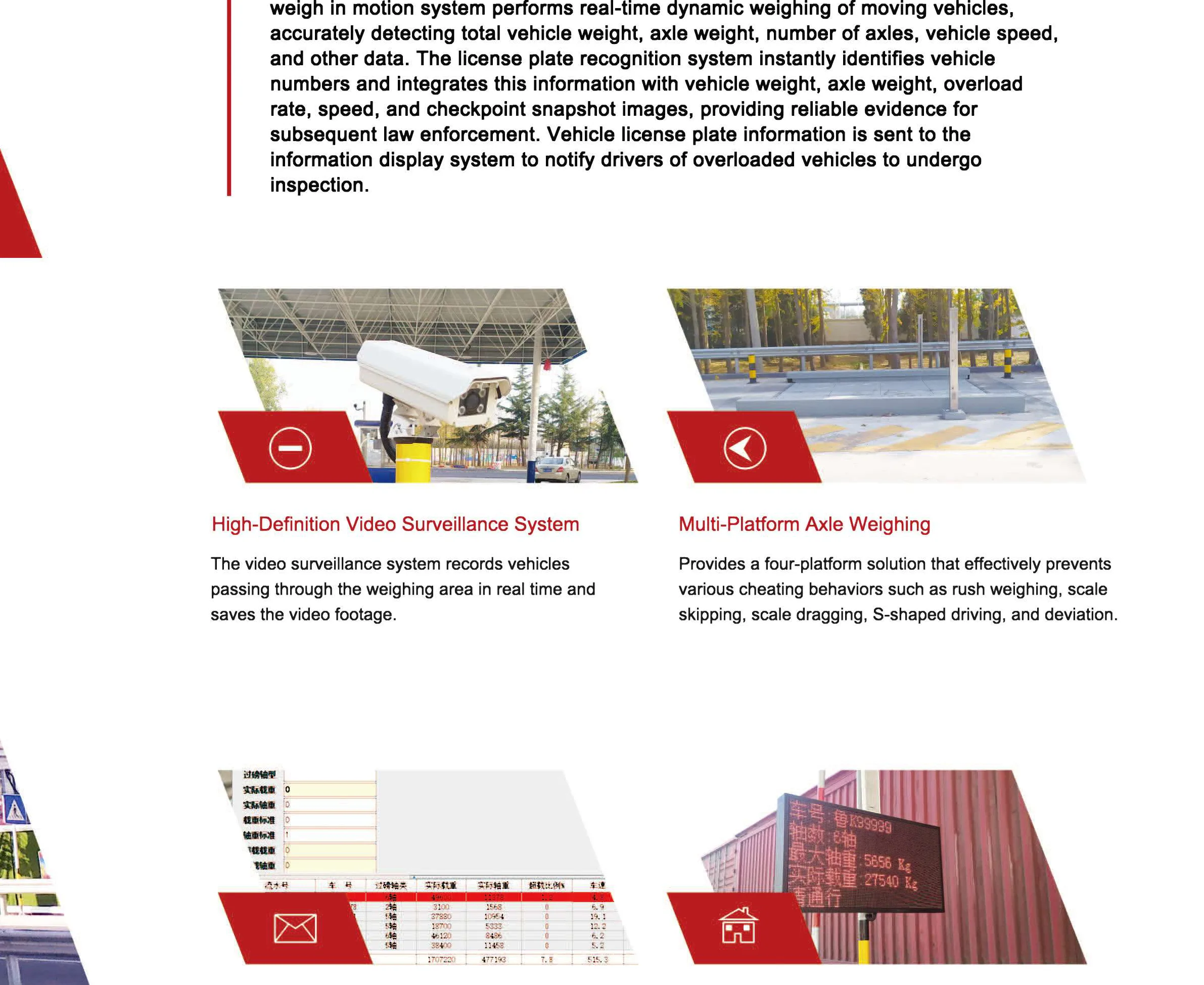
Our standard platform is 3500 × 1000 mm, with a widened 4200 × 1000 mm option for broader lanes and wide-bodied or container traffic. Where vehicles differ a great deal in axle configuration, a ZDG-type multi-platform weighbridge is worth considering: each platform weighs independently, so axle loads and gross weight are captured in a single pass and the layout can be adapted to different wheelbases. That is more flexible than forcing every vehicle onto one fixed-length deck.
Custom deck sizes are available - send the vehicle drawings or an axle-spacing sketch so deck length, width and sensor count are sized from the actual fleet. Also settle pit-mounted versus pitless now: a flush pit deck saves approach ramp length, while a pitless deck sits above grade and is easier to inspect and drain. The choice affects the civil works, drainage and how a technician reaches the load cells later.
Capacity class is also a build-quality decision
A nominal tonnage figure says very little on its own. Two weighbridges both labelled 100 ton can have very different service lives, because what wears a deck out is repeated loading over years, not one heavy truck. When you compare quotations, read past the capacity line and ask how the structure is built and protected.
Our decks are fully welded U-steel structures with sealed internal chambers that keep water and corrosive contamination out of the load-bearing sections. Each deck design passes 2,000,000-cycle third-party fatigue testing, which is a far more meaningful indicator of longevity than a static load rating. Surface preparation is Sa2.5 shot blasting followed by two coats of primer and two coats of finish, giving a dry film thickness of at least 120 microns — the kind of coating specification that matters in humid, coastal or chemically aggressive sites.
Details that reduce downtime matter too: a mid-span lap joint design avoids deck lifting and cuts lateral sensor stress, a cover-free deck protects the load cells, and robotic welding on all seams gives consistent penetration under heavy repeated loads. None of these appear in a headline capacity figure, but they separate a scale that stays accurate from one that spends its life being re-levelled. Ask the supplier to put the build description in writing.
Site requirements: foundation, drainage and access
The best weighbridge will still give trouble on a badly prepared site, and civil works are usually the part of the project that a buyer underestimates. Start with the ground: the foundation needs to be level, stable and designed for the concentrated loads the deck will transfer. A geotechnical look at bearing capacity and settlement is cheap compared with re-levelling a sunk foundation.
Water is the enemy of any static scale. Plan drainage so that rainwater and wash-down water cannot pool under or around the deck, and keep the pit or the area beneath a pitless deck clear of silt and debris. Sealed chambers help, but they are not a substitute for a working drain. Include the approach apron in the plan: vehicles need a straight, level run so they can come to a complete stop fully on the platform, and the approaches must be long enough for the longest vehicle to straighten up before weighing. Note where the indicator, the operator cabin, the power supply and any lighting or barrier equipment will sit, and confirm cable routes between the deck, the junction box and the readout.
If you are considering unattended operation, raise it now - cameras, barriers and remote data handling change the power, network and housing requirements, and our unattended weighing solution is built around those conditions. Our team provides installation guidance and commissioning support; see the delivery and service page. Getting these points onto the drawing before the pour is the biggest single cost saving in the project.
Commercial terms worth settling early
Finally, fix the commercial frame before comparing quotations, otherwise you will compare numbers that do not mean the same thing. Incoterms shift who pays for and manages inland freight, export clearance, ocean freight, insurance, destination customs and final unloading. We quote across EXW, FCA, FOB, CNF, CIF, DAP and DDP, so decide which point of delivery you actually want priced. A DDP figure and an EXW figure for the same machine are not comparable line by line.
The other terms are straightforward: payment by T/T, minimum order quantity 1 unit, typical delivery around 60 days. We are trusted in 70+ countries and produce 10,000+ units a year, so spare parts and configuration knowledge are not tied to one project. Because R&D, manufacturing, installation and maintenance are in-house, the same organisation that answers a pre-sale specification question supports the equipment later.
A well-formed request for quotation pulls all of the above into one document:
- Heaviest loaded gross vehicle weight and axle layout
- Longest wheelbase and overall vehicle length
- Peak and average daily weighings, and the intended use
- Preferred platform dimensions, pit or pitless layout
- Site drainage, power and space constraints
- Chosen trade term and destination country
Ready to turn your vehicle and site data into a specification? Send the checklist above to our engineers through the contact page and we will reply with a configuration and a quotation, MOQ 1 unit, with no obligation.